

ISBN-10
--
ISBN-13
--
Material ID : 20658
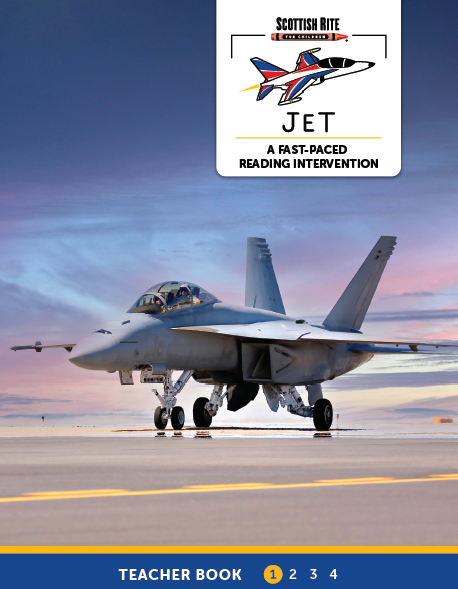
Jet: A Fast-Paced Reading Intervention
Authors
Publisher
Scottish Rite for Children
Category
Intervention
Description
Jet: A Fast-Paced Reading Intervention (Jet) is a curriculum written by the staff of the Luke Waites Center for Dyslexia and Learning Disorders of Scottish Rite for Children (SRC) hospital in Dallas, Texas. Jet builds on the success of four previous Orton-Gillingham based dyslexia intervention
programs developed by the staff of SRC: Alphabetic Phonics, the Dyslexia Training Program, the TSRH Literacy Program, and Take Flight: A Comprehensive Intervention for Students with Dyslexia (Take Flight).
Similar to its predecessor called the TSRH Literacy Program, Jet is intended to meet the needs of older learners, i.e., individuals identified with dyslexia at some point after middle school. However, the more recent, Take Flight, is the model for the content and format of Jet. Consequently, Jet incorporates the most up-to-date knowledge in the field of dyslexia intervention, including data collected at SRC. Both curricula were developed to enable students
with dyslexia to achieve and maintain better word recognition, reading fluency, reading comprehension and aid in the transition from a therapy setting to “real world” learning.
The unique feature of Jet is the much faster pace of presenting the same level of comprehensive instruction characteristic of Take Flight. While, for most students, Take Flight is delivered over the course of two school years, Jet can cover the same range of information in about one school year (two semesters). The impetus for developing a fast-paced program is to meet the needs of learners who were not identified or did not receive effective dyslexia intervention in elementary or middle school. One goal is to decrease the 19 percentage point disparity in high school completion, which for students with learning disabilities is only 62% compared to 81% for those without a learning disability.
Jet is a suitable option for learners with dyslexia, ages 14 years and older who have the capacity to benefit from a fast-paced intervention. The frequency of instruction remains the same as Take Flight, namely, 4 days per week for 60 minute sessions or 5 days per week for 45 minute sessions. However, for Jet each lesson contains a much greater quantity of new learning. This fast pace is intentional to keep the learners engaged and moving through the comprehensive content in about one school year. Jet is designed for small group instruction (four-six students) for a minimum of 45 minutes per day, five days each week. Alternatively, the lessons can be taught for 60 minutes each day for four days a week. It is designed for use by academic language
practitioners and academic language therapists who have been taught to use the program with fidelity. For interventionists who have already achieved status as an academic language practitioner or academic language therapist, this requires one day of training with ongoing support as necessary.
Jet presents, at an age-appropriate level, all five components of effective reading instruction supported by the National Reading Panel research meta-analysis and mandated by the No Child Left Behind Act: Phonemic Awareness, Phonic Skills, Vocabulary, Reading Fluency, and Reading Comprehension. Just as in Take Flight, Jet instruction of every component is explicit. All components are presented in a logical, systematic and cumulative way so that new learning builds on previously taught skills.
Placement of every student begins with Lesson 1. This is because the program is cumulative and, although much of the material may seem familiar in the early lessons, every student still has the opportunity to explicitly review and bring to mind the concepts before they are built upon in subsequent new learning. This is very important for older learners who may have previously unidentified gaps in their baseline knowledge; in short, no one knows what they don’t know, until it is shown to them.
Jet is designed for small group instruction (four–six students) for a minimum of 45 minutes per day, five days each week. Alternatively, the lessons can be taught for 60 minutes each day for four days a week. Jet includes 93 lessons for a total of 124 hours of direct instruction. In the first 28 lessons (Book 1) of Jet, three new grapheme-phoneme rules are introduced each day. This program directly integrates grapheme introduction, phonemic awareness and spelling. Students apply their phonics knowledge reading single words and sentences that combine each lesson’s new rules with previously learned material. Each lesson has additional opportunity for practice of the new phoneme during direct phonemic awareness and spelling exercises.
The lesson cycle takes on a new look with Book 2. On alternating days, the lessons continue new grapheme-phoneme introductions with additional practice of all learned decoding rules. The alternative lessons provide the opportunity to practice previous learning through time, repeated
practice to improve reading fluency. These lessons also include comprehension strategy instruction and 20 minutes of oral reading of connected text that provides necessary practice for newly learned strategies.
With Jet, students will learn all 44 phonemes of the English language, 96 grapheme-phoneme correspondence rules and 87 affixes. The students will also learn spelling rules for base words and derivatives. Practice opportunities are also provided that are designed to improve oral reading fluency. Finally, Jet introduces comprehension and vocabulary building strategies for both narrative and expository text in the context of oral reading exercises, preparing student for successful, independent reading.
programs developed by the staff of SRC: Alphabetic Phonics, the Dyslexia Training Program, the TSRH Literacy Program, and Take Flight: A Comprehensive Intervention for Students with Dyslexia (Take Flight).
Similar to its predecessor called the TSRH Literacy Program, Jet is intended to meet the needs of older learners, i.e., individuals identified with dyslexia at some point after middle school. However, the more recent, Take Flight, is the model for the content and format of Jet. Consequently, Jet incorporates the most up-to-date knowledge in the field of dyslexia intervention, including data collected at SRC. Both curricula were developed to enable students
with dyslexia to achieve and maintain better word recognition, reading fluency, reading comprehension and aid in the transition from a therapy setting to “real world” learning.
The unique feature of Jet is the much faster pace of presenting the same level of comprehensive instruction characteristic of Take Flight. While, for most students, Take Flight is delivered over the course of two school years, Jet can cover the same range of information in about one school year (two semesters). The impetus for developing a fast-paced program is to meet the needs of learners who were not identified or did not receive effective dyslexia intervention in elementary or middle school. One goal is to decrease the 19 percentage point disparity in high school completion, which for students with learning disabilities is only 62% compared to 81% for those without a learning disability.
Jet is a suitable option for learners with dyslexia, ages 14 years and older who have the capacity to benefit from a fast-paced intervention. The frequency of instruction remains the same as Take Flight, namely, 4 days per week for 60 minute sessions or 5 days per week for 45 minute sessions. However, for Jet each lesson contains a much greater quantity of new learning. This fast pace is intentional to keep the learners engaged and moving through the comprehensive content in about one school year. Jet is designed for small group instruction (four-six students) for a minimum of 45 minutes per day, five days each week. Alternatively, the lessons can be taught for 60 minutes each day for four days a week. It is designed for use by academic language
practitioners and academic language therapists who have been taught to use the program with fidelity. For interventionists who have already achieved status as an academic language practitioner or academic language therapist, this requires one day of training with ongoing support as necessary.
Jet presents, at an age-appropriate level, all five components of effective reading instruction supported by the National Reading Panel research meta-analysis and mandated by the No Child Left Behind Act: Phonemic Awareness, Phonic Skills, Vocabulary, Reading Fluency, and Reading Comprehension. Just as in Take Flight, Jet instruction of every component is explicit. All components are presented in a logical, systematic and cumulative way so that new learning builds on previously taught skills.
Placement of every student begins with Lesson 1. This is because the program is cumulative and, although much of the material may seem familiar in the early lessons, every student still has the opportunity to explicitly review and bring to mind the concepts before they are built upon in subsequent new learning. This is very important for older learners who may have previously unidentified gaps in their baseline knowledge; in short, no one knows what they don’t know, until it is shown to them.
Jet is designed for small group instruction (four–six students) for a minimum of 45 minutes per day, five days each week. Alternatively, the lessons can be taught for 60 minutes each day for four days a week. Jet includes 93 lessons for a total of 124 hours of direct instruction. In the first 28 lessons (Book 1) of Jet, three new grapheme-phoneme rules are introduced each day. This program directly integrates grapheme introduction, phonemic awareness and spelling. Students apply their phonics knowledge reading single words and sentences that combine each lesson’s new rules with previously learned material. Each lesson has additional opportunity for practice of the new phoneme during direct phonemic awareness and spelling exercises.
The lesson cycle takes on a new look with Book 2. On alternating days, the lessons continue new grapheme-phoneme introductions with additional practice of all learned decoding rules. The alternative lessons provide the opportunity to practice previous learning through time, repeated
practice to improve reading fluency. These lessons also include comprehension strategy instruction and 20 minutes of oral reading of connected text that provides necessary practice for newly learned strategies.
With Jet, students will learn all 44 phonemes of the English language, 96 grapheme-phoneme correspondence rules and 87 affixes. The students will also learn spelling rules for base words and derivatives. Practice opportunities are also provided that are designed to improve oral reading fluency. Finally, Jet introduces comprehension and vocabulary building strategies for both narrative and expository text in the context of oral reading exercises, preparing student for successful, independent reading.
notes
Pricing Structure: Each teacher needs to set up an account (see How to Set Up an Account). The price sheet clearly states all materials and cost to set up a classroom to teach Jet (see Jet Price Sheet).
edition
First Edition
Pricing Models
No pricing models or cost proposal PDF documents found.
Ancillaries / Related Materials
No related materials found.
UTAH STATE BOARD OF EDUCATION
250 East 500 South
Salt Lake City, UT 84111-3204
Phone: 801.538.7807